Fresh from FETC: My biggest takeaways
FETC felt fast‑paced in the best possible way. It was the kind of environment where you’re constantly catching sparks of ideas as you move from session to session. What surprised and energized me most was how far AR and VR have come since even last year; the tools feel more intuitive, more accessible, and far more aligned with real instructional needs. Across the conference, a clear theme emerged: educators are becoming more intentional about how they use technology, not just chasing the newest tool but asking whether it truly supports learning. And vendors are responding; I saw accessibility features woven into products in ways that will benefit every learner, not just those who require accommodations. It felt like a collective shift toward tech that is both innovative and deeply human-centered.
🎙️ Podcast Highlights
I also had the chance to spend time with the X-Factor EDU team for a FETC kick-off podcast on the first day, which was such a fun way to reflect on the week in real time. We talked about the sessions Dan Ryder and I were leading, the themes behind my roundtable, and the bigger questions we’re exploring this year around creativity, identity, and immersive learning. Once the episode is live, I’ll share the link; it captures the energy of the conference and the ideas that kept surfacing in every room I stepped into.
🎲 Roll for Innovation: Session Highlights
Dan Ryder and I’s Roll for Innovation poster sparked some great conversations, especially around AI ethics and standards and how game thinking can align with the 5E’s in meaningful, classroom‑ready ways. Attendees were curious about how these frameworks can help students move beyond compliance and into real creative problem‑solving, and the discussions that unfolded felt thoughtful and grounded. One moment that really affirmed my approach was how many people gravitated toward my one‑pager prompt—the choose‑your‑own‑adventure flowchart. It gave educators a concrete, playful way to imagine assessment differently, and seeing them light up as they followed the pathways reminded me why I love designing tools that make innovation feel accessible. You can find the one-pager at this link.
🕶️ Secret Identities: Session Highlights
One of my favorite moments from the Secret Identities, Shared Realities poster session was when Dan and I found ourselves reminiscing about our pilot virtual exchange—a project where we worked with 40 international teachers from 25 countries to explore how digital comics can open doors for identity, agency, and cross‑cultural storytelling. That experience shaped so much of what we shared at FETC, and it clearly resonated with attendees. People were especially drawn to the “build your own superhero” graphic organizer, a simple but powerful tool that helps students design a hero who can tackle big problems in their world. This activity is completely content‑agnostic and endlessly adaptable. Educators also loved seeing how Dan layers multiple AI tools into a single storytelling project, giving students new ways to demonstrate comprehension and understanding through visual evidence. The conversations that followed felt hopeful and grounded, the kind that remind you how creative and capable students become when we give them the right structures to express who they are. You can find the one-pager and supplemental resources here.
I always forget how much I adore poster sessions until I’m standing in the middle of one. There’s something so special about the mix of informal conversation, spontaneous questions, and the chance to share ideas in a way that feels human and low‑pressure. I love meeting new people, reconnecting with familiar faces, and watching someone’s eyes light up when a visual or framework clicks for them. And honestly, one of my favorite parts is the design itself—shaping a story visually, building clarity through layout, and creating something that invites people in. I’m realizing more and more how much joy I get from that process, and I’m starting to think about how I might bring that kind of design support into my work in the future.
🌍 Leadership Roundtable Insights
My roundtable on evolving virtual exchange into immersive, globally connected learning landed in the final hour of the expo, but the ideas behind it echoed everything I’d been hearing all week. The session materials captured those themes—VR/AR, AI, game‑based simulations, and learner‑centered design—and I’m excited to bring that conversation to future audiences.
💡 Favorite Tools & Ideas from the Conference
Corridor conversations → why they matter
The hallway moments are always the heart of FETC for me. I kept getting pulled into conversations about tech, teaching, and life with people who genuinely care about the learners they serve—education leaders, teachers, vendors, everyone. Those informal exchanges are where the real ideas spark.
Dyslexia pens & AI note takers → how educators can use them
I didn’t get to try the dyslexia pens myself, but I heard a lot of buzz about them and even walked by a booth showcasing the technology. Paired with the growing wave of AI note‑taking tools, this kind of support could open up new pathways for students who benefit from alternative ways to process information.
ChatGPT for Educators (free) → workflow boost
The free educator version opens up new possibilities for lesson planning, differentiation, and quick content generation without adding to teachers’ workload. Free until June 2026. https://openai.com/index/chatgpt-for-teachers/ (Warning: I’ve heard it takes some time to register and you’ll need an EDU email address.)
Virtual reality schools → creativity + future‑ready learning
I actually had the chance to step inside a fully realized virtual reality school during the conference, and while I’m holding off on sharing specifics until I get a deeper walkthrough, it was exciting to see what’s possible when immersive environments are designed with learning in mind. I’m a big fan of VR and it’s neat to see this technology improving so quickly.
Drone show → student‑powered innovation
The drone show—designed, coded, and flown by eight high school students from the St. Vrain Valley Schools Innovation Center—was breathtaking. Five hundred synchronized drones lighting up the night was a reminder of what students can do when we give them space, tools, and trust. See it here on Facebook.
Pin trading → community building
And of course, pin trading continues to be one of the most joyful parts of FETC. It’s such a simple way to spark conversations and build connections across the conference.
As I head into 2026, I’m carrying the conversations from FETC with me. Talking with so many educators, leaders, and creators gave me a clearer picture of what people are (timidly) asking for—help with book writing, poster design, organization, and the tools that make their ideas easier to share. I’m already thinking about how to build those into my offerings in ways that feel practical, human, and genuinely useful.
This conference also reshaped how I’m thinking about the year ahead. We’re in an exciting moment where tools are merging into bigger, more integrated ecosystems, and the possibilities for creativity and learning feel wide open. At the same time, there’s a real undercurrent of uncertainty—budget cuts, economic pressures, and the ripple effects of the Department of Education’s closure are on everyone’s mind. What I saw at FETC, though, was a community that continues to show up for learners with curiosity, care, and resilience.
I’m grateful for the conversations, the sparks of inspiration, and the reminders of why this work matters. Here’s to a year of building, experimenting, and supporting each other in all the ways we can.
📥 Be One of the First 100 Subscribers
I’m releasing my new Content Repurposing Map soon — a tool to help you turn one idea into many without burning out.
The first 100 subscribers will get early access before it launches publicly.
Subscribe here: https://forms.gle/a621LsXqnDGzaAB27
⭐ Where You Can Find Me In‑Person This Year
If you’ll be at any of these events, I’d love to connect, and if you see me, please say hi! I’m always excited to meet educators, creators, and leaders doing meaningful work.
You can also book an in‑person discovery call with me during any of these conferences. Just reach out and we’ll find a time that works. https://www.jacquiegardy.com/contact
📍 EduCON — Philadelphia, PA
January 30–Feb 1, 2026
Presenting: Leading Critical Creativity for Leadership & Changemaking
(If you’re within driving distance, this is one of the best small conferences out there—thoughtful, conversational, and full of incredible food and culture.)
📍 SXSW EDU — Austin, TX
March 2026
Mentoring: Date/Time/Slots TBA
Attending sessions, meetups, and creative learning conversations
📍 ACES: The Society for Editing — Atlanta, GA
April 2026
Connecting with editors, writers, and publishing professionals
📍 ISTE Live 2026 — Orlando, FL
June 2026
Presenting two sessions:
Critical Creativity in Action: Building Critical Thinking Skills through Classroom Ecosystem Design (Poster Session)
Tabletop Thinking and Learning: A Game-Based ISTE Playground
📍 Additional Events Later in 2026
I’m planning to add more conferences to my calendar this year. These are some of the ones I’m considering proposing sessions for:
Games for Change Festival
MassCUE
TETC (Tennessee Educational Technology Association)
Pax Unplugged (Penny Arcade Expo)
NYSCATE (New York Association for Computers and Technologies)
NCTE (National Council of Teachers of English)
More dates coming soon—and if you have recommendations, I’d love to hear them! Thanks for those of you who’ve already reached out with suggestions!
Thanks for reading!
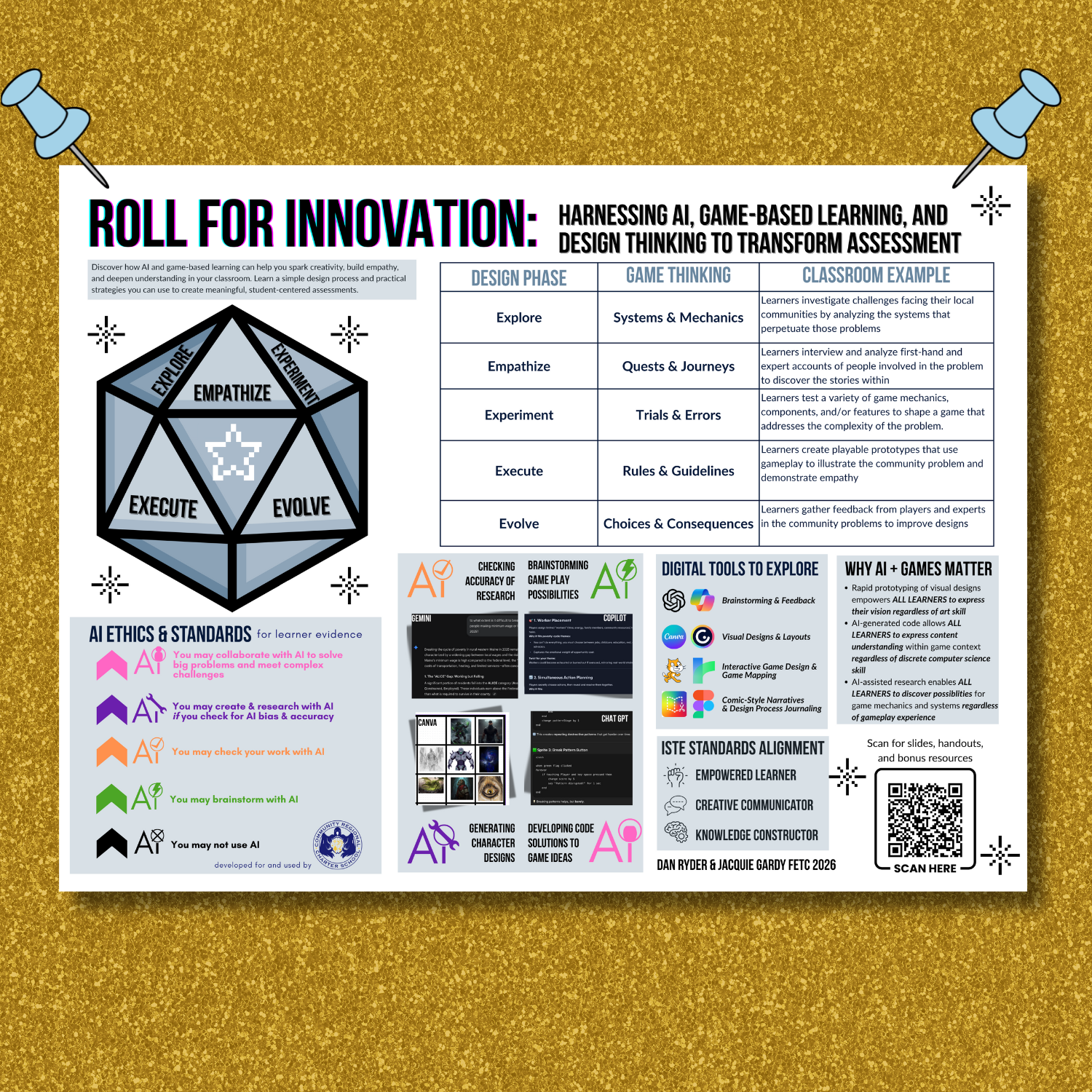
Roll for Innovation Poster - FETC 2026- Ideas by Dan Ryder & Jacquie Gardy, designed by Jacquie Gardy.
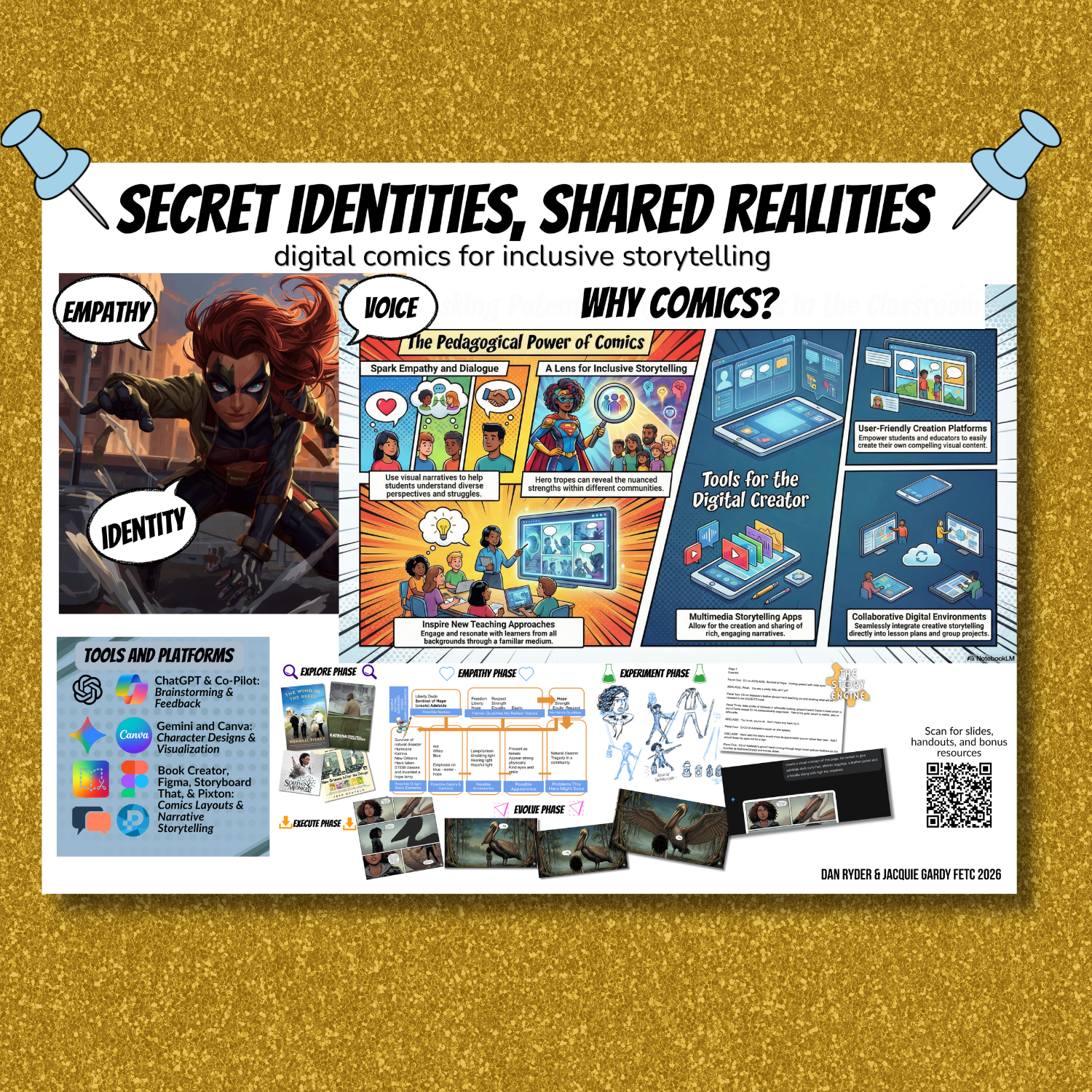
Secret Identities, Shared Realities- FETC 2026- Ideas by Dan Ryder & Jacquie Gardy, designed by Jacquie Gardy.